test post
About Me
Hello there, my name is Nicole Ciesinski. I was born and raised in Bethesda, MD, I love dogs and chocolate, and have a passion for dancing, science, math and music. This is my website and I hope you enjoy!
Week 9 notes document
Here’s a Google doc for all of us to keep notes in for the 9th week of the semester.
Collaborative Essay
At first, the collaborative essay in the Google doc was very hectic. I have never experienced any type of group essay before. Every student was trying to type down an idea to contribute to the paper. Each student seemed to be working on a different part of the document. Many students were editing each other’s work which was very frustrating at times. After fifteen minutes of chaos and writing we began to organize the paper and communicate with one another. Each person seemed to find a specific part of the essay to improve. The chat bar definitely helped us organize the paper effectively. I focused on finding examples from Maus to add to the paper. After twenty minutes of everyone working together we ended up with a little more than four pages of a somewhat organized essay. I was amazed by how much writing we could all get done together in such a short amount of time. Being new to the experience was a little stressful but by the end of the class I was pleasantly surprised by the essay my classmates and I put together. If we ever write a collaborate essay again I think we would all save some time if we organized the essay before we began to write. I hope to repeat this process and learn even more from the next collaborative essay.
My badge
 In my first conference this morning, I realized that I never posted the badge that I made a little while ago! Oops.
I used “\m/ Hair Metal \m/” by Flickr user Stéfan.
Readers 3/5
In relation to the recent events of Uganda and South Carolina, we can see a connection between the concealment of Alison’s dad’s homosexuality to the general public. By having a family, he abided by the “family-centered mainstream culture” (Scott Lively). This is also portrayed in his obsession for restoring the house. Alison’s father stops at nothing to give their house a normal appearance but in reality it is a funeral home. This superficiality in his life may have led to him being depressed, and eventually self destructive.
Self-destructiveness is displayed in him having a picture of Roy almost naked on page 101. Holding onto it is self-destructive in itself as it may give rise to sexual temptation. The year of the picture is crossed out, perhaps indicating that Roy may have been underage at the time; hinting at a possible affair between Allison’s dad and Roy.
Alison’s father made sure she dressed in a feminine manner, as displayed on page 97 when her dad asked where her barrette was and threatened to ‘wale her’ if he caught her without it again. He also made a deal about the woman who was dressed
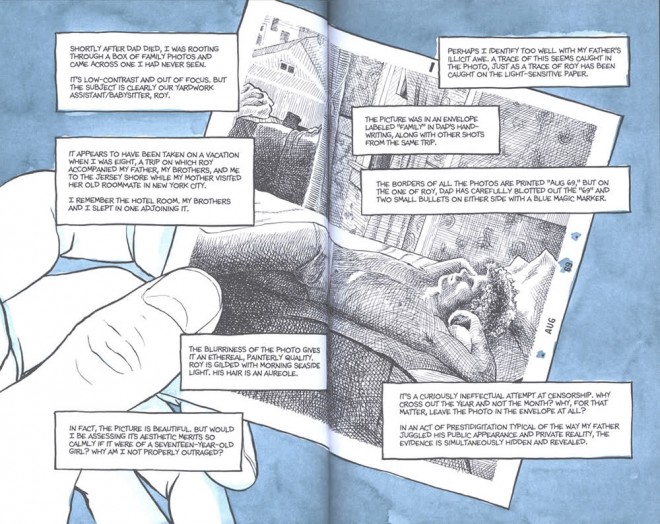
Credit for the picture: http://sequart.org/images/fun-home-roy-660×524.jpg
Conferences
Go to the Doodle poll. Type your name and then check all the times when you are available to meet. I’ll send a first round of emails before 9:30 letting you know when you’ll meet. You can comment here or email me if you have questions or concerns.
Historians 2/28
This week, on Tuesday we spent a good bit of time discussing our Maus tracing project. A number of people had issues with their blogs so the first portion of class was somewhat devoted to discussing and troubleshooting those formatting issues. During the second portion of class we looked at, and dissected a HORRIBLE representation of a standard five paragraph essay. Key word: standard. We basically looked at and learned all of the reasons that the intro and conclusion are redundant and inherently unnecessary. On Thursday we spent the entirety of class discussing Fun Home and the patterns that we have noticed therein. One of the most important that we found mostly had to do with the dark humor and the way the all the other themes are kind of wrapped up in that.
An interesting thing that I read more about is the situation at the University of Charleston and USC. http://www.washingtonpost.com/blogs/govbeat/wp/2014/02/21/south-carolina-legislators-cut-university-funding-over-gay-themed-books/
This situation brings up lots of interesting points, specifically whether or not legislators have a place in regulating education.
Historian Blog Assignment
https://docs.google.com/document/d/1nCsyqvHYNCWE3WKwlBbwySykV3xrlQDDfSrfThVjA_4/edit
Further questions for today
In their readers post last night, Ethan, Nikki, Mike, and David mentioned recent events in Uganda and South Carolina, which treat homosexuality “as something that should be kept behind the scenes to oneself.” I’d like to point you to a few secondary sources on these events from last week and pose a question or two.
Uganda passed a law criminalizing homosexuality last week, so consenting adults who engage in homosexual sex might be punished with life in prison and anyone who is found to be counseling gay people faces 7 years in prison. Here is the Wikipedia article describing the law. The next day, one of the Ugandan tabloids published “EXPOSED! Uganda’s 200 Top Homos Named,” which seemed to be a provocation not only for the police but for vigilantes to go after the people identified.
Some American pastors served as consultants for the nation of Uganda in drafting this bill, including Scott Lively, an anti-gay activist best known for his book The Pink Swastika, which has been thoroughly discredited by historians but that blames the Holocaust on homosexuals. Lively’s organization has been officially designated by the Southern Poverty Law Center as a hate group. Lively was interviewed by NPR’s Michele Martin on 2/27 about the Ugandan law and gay rights. The first part of the story may or may not be interesting to think about, but the reason I’m linking you to this interview is the ending. Lively says that perhaps the Ugandan law is a tiny bit extreme, and proposes his own best case scenario for how homosexuality should be handled in the US, to return to the times before the Stonewall Riots Alison Bechdel describes in chapter 4. Lively says:
Well, I believe that societies of the world have an affirmative duty to protect the natural family and to discourage all sex outside of marriage. And I’m talking about adultery, fornication, homosexuality, incest, all of it. But I also believe that in our societies we should have, you know, reasonable tolerance for people who decide to live outside the mainstream discreetly. I think we had a pretty good balance in the 1940s and ’50s in this country. Unquestionably, it was a family-centered mainstream culture and subcultures in which homosexuals and others could live out their lives and be happy.
There’s also an article from last week about the South Carolina legislature punishing the College of Charleston for including Fun Home on a list of recommended reading over the summer. One legislator in South Carolina said that it is inappropriate to have open discussion in college classrooms about homosexuality–that such topics are not worthy of scholarly attention. Bechdel is quoted as replying, in part, that “It’s sad and absurd that the College of Charleston is facing a funding cut for teaching my book – a book which is after all about the toll that this sort of small-mindedness takes on people’s lives.”
Think about these sources and chapter 4 of Fun Home.
- What does Bechdel mean when she asserts that Fun Home is about “the toll that this sort of small-mindedness takes on people’s lives”?
- If Lively got his wish and we returned to the 1950s when gay people kept their sexuality “discreet” and hidden from the outside world, then would everyone get to “live out their lives and be happy,” as he asserts?
- Based on what we’ve read of Bechdel’s book, what sorts of impacts might such a cultural and legal turning back have?