Panel 1 -before annotation Panel 2 -before annotation
Panel 1 -after annotation Panel 2 -after annotation
Reading the graphic novel Maus by Art Spiegelman really hit me in ways that I never thought about before. This is because I am Jewish, and this is a book about the Holocaust. It brought to my attention different aspects about the horrible time period. The fascinating thing to me was that I was able to have these realizations solely from the panels that the novel consists of. Upon reading Maus, two specific pages of panels caught my attention. The first panel that caught my attention was on page 113 of the first book. There is a significant backstory behind this panel. As many people know, the Jews were persecuted during the Holocaust and in order to be rescued some were hidden inside houses. These houses needed to have secret rooms that were out of sight when the Nazi’s came around in search parties. In this page the Jews are hiding in the attic of a house and person that looks like a mouse finds them. This is important because in this novel the Jews are depicted as mice. Since it is a mouse, one would expect the mouse to just see them and look the other way as if they saw nothing. In the first panel the mouse has an exclamation point in the speech bubble. This stuck out to me because it is bolded and clearly the state of emphasis. Upon looking at these panels I realized that Art used different techniques of shading and drawing to emphasize certain ideas. For example, in book 2 on page 82 there is a panel regarding a dog. In order to make the dog the center of focus he shades it in much darker than everything else in the box. This allows to viewer to look more at the dog then the rest of the things in the box. Another thing that I noticed while looking at the different panels are the different emotions of the characters. Normally it would be very difficult to show an emotion in a graphic novel because all of the panels consist of pictures with very few words. That is why it is called a graphic novel. In this panel of book one on page 113 the emotion of the mouse is emphasized solely because there is a crevice in his head that is drawn. Drawing these little lines may seem insignificant, but it is this little line that shows the emotion of nervousness for the entire panel. It is pretty amazing what a little line can do to a picture. Art also uses two panels’ similarly to create a theme as well. This is represented in book 2 where there is a story told about a dog that got shot because it was disturbing people. There are two boxes that are identical, one with a dog and one with a mouse to emphasize that the person was treated in the same way that a rabid dog was treated. This is very important because it is once again a great technique to let the reader really feel remorseful over the death of the person. The Nazi’s treated the Jewish people just like a rabid, crazy dog would be treated and words weren’t even needed to show this.
One of the most important parts of tracing the panels was noticing the difference between the large and small boxes. I noticed that the larger boxes were usually much more important and had a lot more meaning to them than the smaller ones. On both panels that I traced, there were panels much larger than others. An example of this was in book one where there was a large panel depicting the Jewish people getting discovered by the Nazis because the man who they let go betrayed them and was an informant. Another example of this was on page 82 of book two. The image of the Jewish people walking past the dead body is one of the most moving and emotional panels in the book, and that is why it is so large.
Upon tracing the different panels I found myself leaving out certain things. These included certain shadings and markings. I decided to leave these out because I felt that they were unimportant and didn’t depict what the author was really trying to emphasize in that specific panel. Maus could not have been anything but a graphic novel because the author was really able to capture the little details of importance in the story by shading in certain things and changing panel sizes to depict the importance of moments.


Book I & Book II
Pg. 86 Pg. 64
What did you find yourself leaving out of the tracing?
Obviously, the words… but with the words, sometimes the meaning left too. The tracing itself took time… I feel like for one of my pages, I left out the “backbone” of the page—the text somehow held it together. Without the text, page 31 is just a page of unexciting drawings. It shows an equality shared by all the mice—an equality of disdain and simplicity. However, page 95 doesn’t lose any of its impact when you remove the text. It is almost just as powerful as the illustrations alone. The pain and suffering in the drawings themselves affects the reader.
What did you find yourself striving to include in the tracing?
I wanted to include textural details—lines, different layers of shadings, patterns, etc. I wanted to capture every distinctive characteristic ranging from the deepness of the shading, to the detail in in the walls.
Why?
The smallest detail could make a difference. In page 95, for example, leaving out a single detail in the eyes of the dead takes away a significant amount of impact the illustrations have on the reader.
What did the act of tracing reveal about the page?
It revealed different things for both pages: For page 31, the act of tracing revealed similarities between all the characters—both important and unimportant. Instead of focusing on Vladek, I was searching for him in a crowd of mice. It almost took away more from the page than it revealed. On page 95, the act of tracing showed me the detail that Spiegelman put into the dead. The drawings were meant to affect you as you looked at them—not just scare you. Drawing the eyes of the dead was probably the most impactful moment of this assignment.
What did the product of your tracing reveal?
The products of this assignment were unusual. Page 95 didn’t change to me at all—it was still impactful and noticeably important to the novel. Page 31 lost its luster. Without the words, it just didn’t tell a story. That may be my fault for choosing the page, but I think it shows the importance of mixing words with pictures. It’s an art that Spiegelman mastered in Maus.
How closely does your tracing capture the dominant narrative or visual themes of the overall work?
I think Page 95 shows the importance of the illustrations to Maus as a whole—it exhibits the effects of a dark time. It instills within readers feelings of fear, sadness, and grief. Page 31, on the other hand, reveals the importance of the text to a graphic novel. Sure, pictures can tell a story. But, you lose the meaning behind the pictures if the wrong words are removed.

Maus: Part II, Page 31

Maus: Part II, Page 95
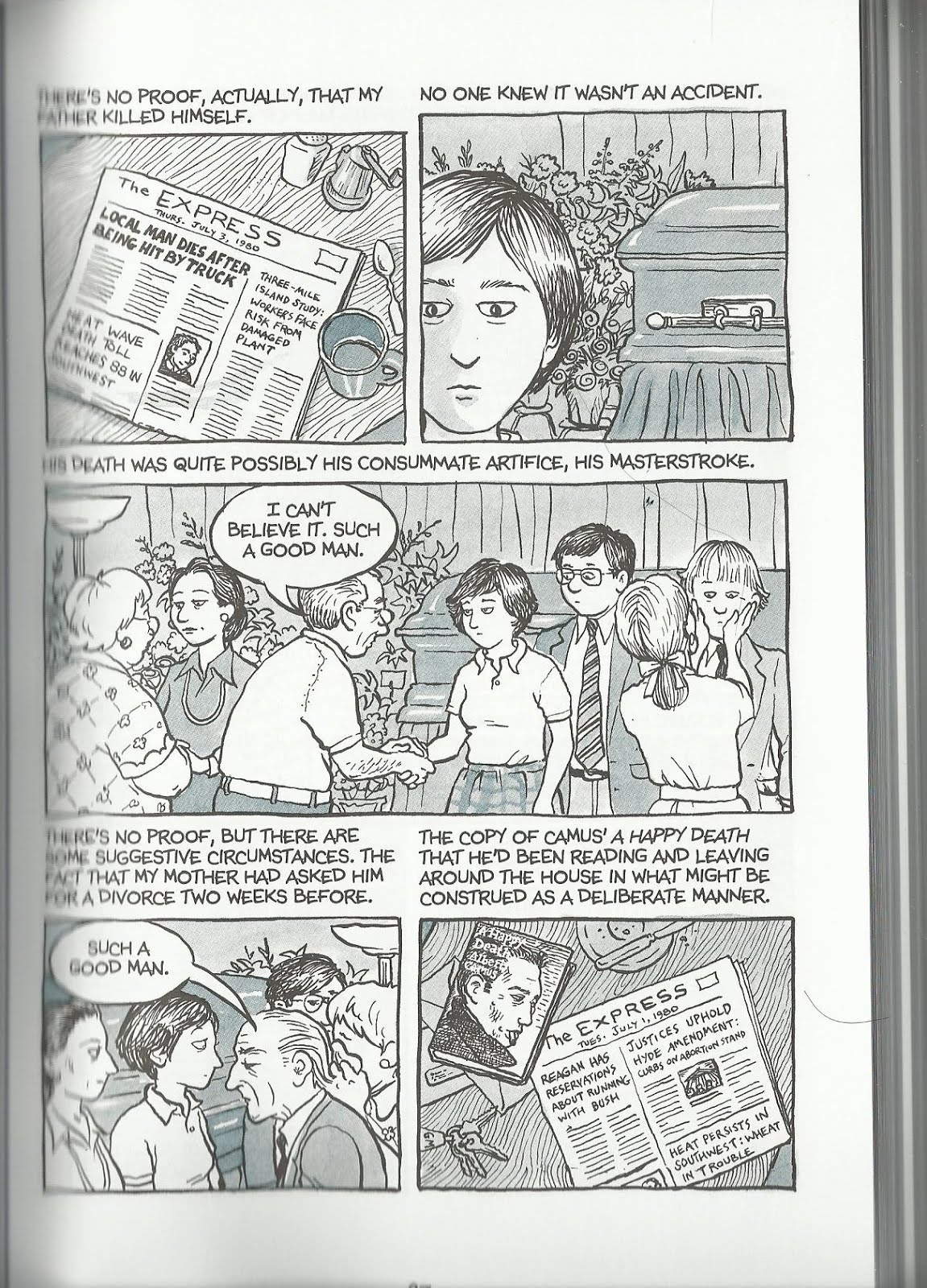
Fun Home is a book in which Alison describes her upbringing in a home in which her father had a very dominant role, up until his death. The peculiarity in his attitude is multifaceted. The majority of the time, he is a figure who is extremely obsessive over material objects. He was constantly refurbishing their house in a multitude of ways, and wouldn’t hesitate at all to demand the help of others. His love for his material objects is on clear display on page 14, where Alison says, “I grew to resent the way my father treated his furniture like children, and his children like furniture.” He was even shown to beat his children.
Under the public eye, he was seen as a very admirable man. On page 27, the scene of his funeral, another man was quoted on saying, “I can’t believe it. Such a good man.” “Such a good man,” was then repeated on the following panel. This shows how all his violent and obsessive behavior was only in effect at places of secrecy, such as their house. In addition, yet another secret withheld from the general public was that he was a child molester, as hinted on page 17.
Alison’s calm and emotionless manner during her father’s passing is evident through her calm and detached storytelling of her father’s death. She lists possible proofs as evidence that her father truly committed suicide. For example, on page 28, Alison draws the reader’s attention to a specific highlighting her dad created in Albert Camus’s novel of A Happy Death. She even mentions that the highlighted sentence would be “A fitting epitaph for my parents’ marriage.” Alison then proceeds to analyze more potential evidence of her father’s suicide.
This inexpressive feeling of Alison is also portrayed, perhaps more evidently, through her facial expressions in the panels at the beginning of chapter 2. For example, on page 27, she looks completely uninterested in the praises her father’s friends are giving to her and her family. Alison’s cold and inexpressive demeanor is clear in the second, third and fourth panels on page 27.
Credit for picture: http://lkleincourses.lmc.gatech.edu/archives12/files/2012/11/post5_A.jpg


“What makes these photos different?”
“What makes them similar?”
“What do they say?”
“How do they say it?”
“Why do they appear as they do?”
These are the questions I asked myself as I shuffled through Maus looking for the perfect pictures. I was stuck between several photos, but these two continued to stand out to me–even after I stared at them for hours. However, even now I can’t honestly say what makes these photos unique… Page 31 is light, simple, and almost needs Spiegalman’s text to convey its message. Page 95 is detailed, dark, and somehow awe-inspiring. Even without text, page 95 leaves a lasting impression on the reader. Both of these pages left some lasting mark, because they consistently stayed in the back of my mind as I shuffled through the books of Maus one page at a time…