At first, the collaborative essay in the Google doc was very hectic. I have never experienced any type of group essay before. Every student was trying to type down an idea to contribute to the paper. Each student seemed to be working on a different part of the document. Many students were editing each other’s work which was very frustrating at times. After fifteen minutes of chaos and writing we began to organize the paper and communicate with one another. Each person seemed to find a specific part of the essay to improve. The chat bar definitely helped us organize the paper effectively. I focused on finding examples from Maus to add to the paper. After twenty minutes of everyone working together we ended up with a little more than four pages of a somewhat organized essay. I was amazed by how much writing we could all get done together in such a short amount of time. Being new to the experience was a little stressful but by the end of the class I was pleasantly surprised by the essay my classmates and I put together. If we ever write a collaborate essay again I think we would all save some time if we organized the essay before we began to write. I hope to repeat this process and learn even more from the next collaborative essay.
Uncategorized
Readers 3/5
In relation to the recent events of Uganda and South Carolina, we can see a connection between the concealment of Alison’s dad’s homosexuality to the general public. By having a family, he abided by the “family-centered mainstream culture” (Scott Lively). This is also portrayed in his obsession for restoring the house. Alison’s father stops at nothing to give their house a normal appearance but in reality it is a funeral home. This superficiality in his life may have led to him being depressed, and eventually self destructive.
Self-destructiveness is displayed in him having a picture of Roy almost naked on page 101. Holding onto it is self-destructive in itself as it may give rise to sexual temptation. The year of the picture is crossed out, perhaps indicating that Roy may have been underage at the time; hinting at a possible affair between Allison’s dad and Roy.
Alison’s father made sure she dressed in a feminine manner, as displayed on page 97 when her dad asked where her barrette was and threatened to ‘wale her’ if he caught her without it again. He also made a deal about the woman who was dressed
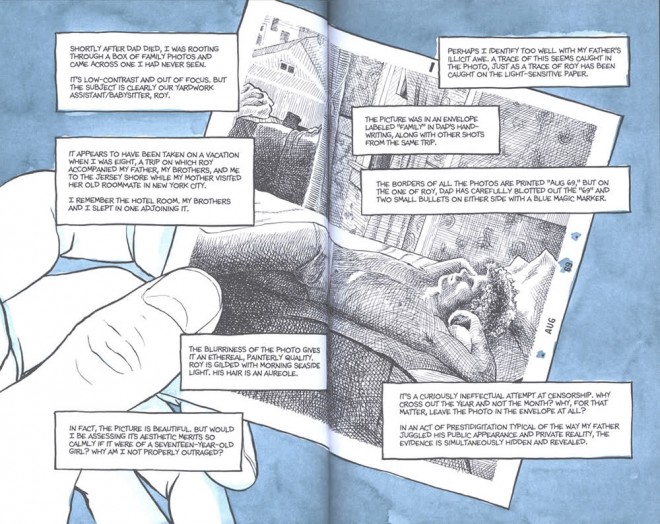
Credit for the picture: http://sequart.org/images/fun-home-roy-660×524.jpg
Historians 2/28
This week, on Tuesday we spent a good bit of time discussing our Maus tracing project. A number of people had issues with their blogs so the first portion of class was somewhat devoted to discussing and troubleshooting those formatting issues. During the second portion of class we looked at, and dissected a HORRIBLE representation of a standard five paragraph essay. Key word: standard. We basically looked at and learned all of the reasons that the intro and conclusion are redundant and inherently unnecessary. On Thursday we spent the entirety of class discussing Fun Home and the patterns that we have noticed therein. One of the most important that we found mostly had to do with the dark humor and the way the all the other themes are kind of wrapped up in that.
An interesting thing that I read more about is the situation at the University of Charleston and USC. http://www.washingtonpost.com/blogs/govbeat/wp/2014/02/21/south-carolina-legislators-cut-university-funding-over-gay-themed-books/
This situation brings up lots of interesting points, specifically whether or not legislators have a place in regulating education.
Historian Blog Assignment
https://docs.google.com/document/d/1nCsyqvHYNCWE3WKwlBbwySykV3xrlQDDfSrfThVjA_4/edit
Readers (3/3)
Based on the readings we did on the weekend (chapter 4 and chapter 5), I can see that floral patterns and flowers in general will come up in our discussion about the reading. One question I have about the book is whether the author is able to make references and links to other books and maps, even, because she’s really knowledgeable and come across them before or because she did some research after her father’s death. It seems too coincidental that many parts of her life fit in with maps, and books that she’s previously read. Another question that arises is about her homosexuality and whether she was inclined towards women naturally or whether her father had shaped her into becoming more tomboy-ish by making her dress certain ways.
In light of the recent events affecting homosexuality in Uganda and in the College of Charleston, this chapter sheds some light on how homosexuality is treated as something that should be kept behind the scenes to oneself. There are several examples of this in chapter 4, where Allison and her group of friends are “86’d” and refused to be let in by the doorman. On the same page, we see that lesbians were required to wear 3 articles of woman clothing during inspection, which depicts them as criminals for being self-expressive. All-women’s clubs like the one pictured below were frequently raided by police.

Photo credit to: http://jamiebobamie.wordpress.com/2012/05/25/lesbian-music-in-the-50s-and-60s/
Responders 2/26

Image Source: http://internetdisease.blogspot.com/2010/10/fun-home-by-alison-bechdel.html
Is Allison really inexpressive? Fun Home is a personal story, yet so far we seem to have taken Alison’s word as gospel. If it’s written it happened. Her father hit them, he was endlessly obsessed with the house, but it is important to realize that this is a memoir, and that we can never really trust the narrator. After all, Allison does have a history of not betraying her emotion (p.44)… or at least she says she does.
It must also be noted that everyone does wrestle with grief differently. Allison portrays herself as calm and unemotional after her father dies, but his death is clearly something she has spent her entire life contemplating, as evinced by the entire existence and focus of the comic itself. While she acted unemotional (or, again, said she did) that does not suggest that the death did not affect her.
Responders 2/27/2014
Is Allison really inexpressive? Fun Home is a personal story, yet so far we’ve seem to have taken Alison’s word as gospel. If it’s written it happened. Her father hit them, he was endlessly obsessed with the house, but it is important to realize that this is a memoir, and that we can never really trust the narrator. After all, Allison does have a history of not betraying her emotion (p.44)… or at least she says she does.
It must also be noted that everyone does wrestle with grief differently. Allison portrays herself as calm and unemotional after her father dies, but his death is clearly something she has spent her entire life contemplating, as evinced by the entire existence and plot of the comic itself. While she acted unemotional (or, again, said she did) that does not suggest that the death did not affect her.
Maus pg. 86 Final Panel

Maus pg. 86 Panels


Maus pg. 86 Unframed Panels
